John Doan Concert in Anaheim September 15, 2012

Eire - Isle of the SaintsEire – Isle of the Saints
by John Doan
CD Price $15.97

The Living Tradition Concert Series represented by Gary Trobridge will present “A Celtic Pilgrimage with John Doan,” Saturday, September 15th, 2012, at The Anaheim Downtown Community Center at 7:30PM. The concert will feature music from John Doan’s award winning recording “Eire – Isle of the Saints” (Winner of “Best Celtic Album of the Year”) and “Wayfarer” (also nominated for the same title).

John’s playing of the 20 string harp guitar takes audiences on a Celtic pilgrimage to the sites made famous by St. Patrick and others during the Golden Age of Ireland. These sites a millennium ago were imaginatively called “Thin Places” where it was believed the space between heaven and earth, and past and future, were thinly divided. The audience is transported back to the very sites where the music was composed enhanced by masterful storytelling.

The Living Tradition is a non-profit organization working for the preservation of traditional music and dance in Southern California. They host contra dances, contemporary and traditional folk music concerts, and traditional music jams nearly every month at the beautiful Anaheim Downtown Community Center in Anaheim, California.

John Doan Concert Tour in Europe 2012

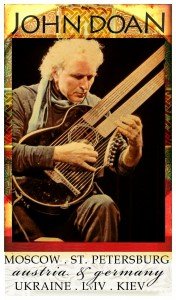
John Doan Concert Poster for Moscow and St Petersburg in Russia and then Ukraine 2012John Doan will be touring in Europe this coming May starting off in Ukraine cities of L’viv and Kiev. Various concerts are scheduled in Germany and Austria and will also include performances in Russia as well. Concerts, workshops and lectures will be conducted in L’viv, Kiev and in Moscow. It will also include many firsts.

John Doan will be formally debuting the 20 string harp guitar Saturday May 5th and Sunday May 6th in concerts in Ukraine, where copies of his Elliott/Sullivan harp guitar will be made in a factory in L’viv. John will soon be posting videos and blog entries about his visit to the Trembita instrument factory of L’viv that will be the first company to manufacture this version of the harp guitar worldwide in cooperation with Jay Buckey Music.

In Russia John will be playing on Thursday May 17th at their first NAMM show (National Association of Music Marketers) and it will be quite the honor to also play elsewhere in the city in the beautiful concert atmosphere of the former 18th Century Roman Catholic Church of Mary Magdalene on Sunday May 20th. His performances in Moscow will introduce the harp guitar in performance for the first time, and he will be performing for the first time ever in Berlin, too.

The Bandura, a Ukrainian stringed instrument that shares various similarities to the harp guitar, is a much beloved national instrument. John will be consulting with Jay Buckey and others on developing more 21 string harp guitars based upon his original Elliott/Sullivan harp guitar, hopefully helping Ukrainians expand their vision for the Bandura into the 21st century! The first concert May 6th will feature Jay Buckey and two Ukrainian vocalists, Alla, and Peter, in cooperation with Trembita instrument factory of L’viv, and celebrating the harp guitar worldwide.

John Doan will perform in Kiev, the capitol of Ukraine, opening with Revatsky Boys Choir under the direction of its chief conductor Aida Zaytseve.

On Friday, May 11th and Saturday, May 12th, 2012, John plays in Germany at the Paul-Gerhardt-Haus in Schwerte and Aula der Realschule in Olpe as part of the international guitar night featuring Fancois Sciortino (France), Andrea Valeri (Italy), and Stefan Moenkemeyer (Germany). Even though John by himself will have more strings on his harp guitar that all the other guitarists combined each of them are so amazing that they will sound like they have as many strings and more than John. Be forewarned, guitarists attending may be inspired to do violent acts to their guitars after seeing this concert. The sponsors take no responsibility for the well being of such guitars.
Continue reading

Beyond Six Strings – From Sor to Hendrix

Last October I had a chance to conduct a Sor Symposium and debut a new show “Beyond Six Strings – from Sor to Hendrix” at Marylhurst University in Portland, Oregon. Months before I had an opportunity to talk with Peter Zisa who conducts the guitar program there about my research in the life and music of Sor, and he suggested that Marylhurst University host a Sor Symposium. Peter is not only a great player and elegant human being, he has such a great imagination and he coordinated with several teacher/performers in the area to have students come to a master class and themselves participate in the Symposium. Both the class and the Symposium went incredibly well.

Peter reviewed the event as follows:

“Marylhurst hosted an historic performance by John Doan on three beautiful and historic instruments. John’s blend of remarkable skills as a storyteller and masterful performer proved to be the highlight of the two-day Sor Symposium. John, who began his performance with his own music and arrangements on harp guitar, concluded the program with a historic premier performance of Sor’s music for the three-necked harpolyre. The pieces, which varied in level of technical difficulty from intermediate to virtuosic, charmed and moved the spellbound audience.”

Fan, Shannon J. Murphy, had this to say about the concert:

I was present at the concert at Marylhurst and was able to relive it as I read your account here. It was a beautiful presentation and I know your future audiences at this concert are going to love it as much as I did. Your description of Sor and his musical technique struck me as being just what I could say of you and yours. You are the instrument that makes the music flow. Continue to walk in the light.

In short, it was a kick!! It seemed crazy to combine in the same show the music of Fernando Sor – the “Father of the classical guitar” with the music of Jimi Hendrix and other contemporary guitar innovators but as the show evolved it flowed beautifully into an event that reached across time, generations, and cultures. Continue reading

The Victorian Christmas Maestro – 700 Club Interview

John Doan was interviewed on The 700 Club for their special on holiday music, “The Victorian Christmas Maestro.” The interview showcased John’s popular annual Victorian Christmas Concert, celebrating 25 years in 2011.

John played “Hark the Herald Angles Sing” on the crankorgan, “It Came Upon a Midnight Clear,” and “Go Tell It On the Mountain” featured on his CD Wrapped In White and Victorian Christmas DVD. He also showcased zithers, banjos, guitars, and other ancient stringed instruments.

The interview article features the transcription of the interview.

John Doan Interview in Austria

After a concert in Wels, Austria, John Doan was interviewed about his Celtic Pilgrimage Concert. In this interview titled, “Sharing a Moment in Time Through Music,” John explains why he focused on Celtic ancient times and music. The background music is from his concert in Wels.

Interview: John Doan Concert in Rigomagno, Italy

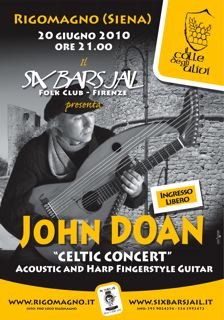
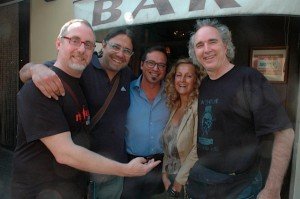
John Doan in Six Bars Jail Concert 2010, ItalyFollowing is an interview published after my visit and concert in Rigomagno – a thousand year old hilltop village in Tuscany, Italy. Used with permission.
We are curious to know how it all began: it’s such a peculiar instrument, how did you get interested in the harp-guitar?

In a world increasingly filled with machine made things that are all made the same I have found it refreshing to celebrate the unusual. I grew up in Venice, California in the United States – a place inspired by Venezia in Italy. I guess beauty and the unusual seemed to go together in my youth and while in my teens I played the 12 string guitar and a double neck electric in a rock band. Later, while studying music at a university I was introduced to classical guitar. I really enjoyed the music for the lute and was amazed at the sound of its many strings. When I later found a century old harp guitar on the back wall of a music store it called to me with its beautiful shape and unusual collection of extra strings. I was achingly curious and wanted to transform its silence and neglect into something alive and vibrant. It was and continues to be an adventure to play music on the harp guitar.

What’s the origin of the harp-guitar? And what about your instrument? Did you have it built especially for you? In this case, where did you find the model? Is it an original model you designed?

John Doan & Six Bar Jail Guitar club in Florence ItalyThe harp guitar in America was first popular from the 1890’s through the 1920’s. People played them in mandolin orchestras, vaudeville shows, and in their parlors. In Europe the harp guitar was becoming popular as early as the 1840’s and grew in popularity up through the early 1900’s especially in Germany and in Italy. Pasquale Taraffo is one of the great Italian masters of the instrument in the early 20th century. To learn more about this amazing player from your own history check out the information on Taraffo on the Harp Guitars site.

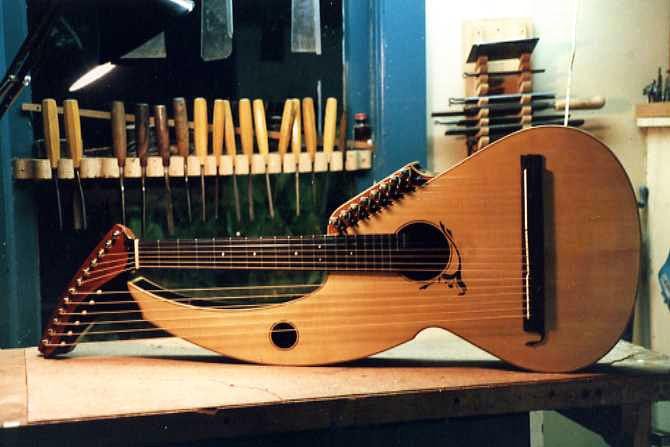
Regarding my instrument, I commissioned it in 1986 from John Sullivan with oversight and design by Jeffrey Elliott of Portland, Oregon. Jeffrey had made guitars for Julian Bream, Ralph Towner, etc. and I was excited to see how he would approach the challenges of so many strings and meet my requirements of evenness of tone using steel strings. Although based on the Knutsen, Dyer, and Gibson harp guitars from a century earlier it was completely redesigned to be a master instrument that would sound evenly across all its range (like the piano). It is considered the “first modern harp guitar” of our times. Scores of copies have been made and it was recently on the cover of the magazine “American Lutherie.”
Continue reading

John Doan Harp Guitar Retreat 2010

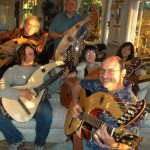
The Harp Guitar Retreat for 2010 was a resounding success. Here are some photographs of the participants exploring the world of the harp guitar.

Irish Philadelphia Interviews John Doan on Celtic Music and Mysteries

Irish Philadelphia published an interview with John Doan called “Harp Guitar Performer John Doan Brings Celtic Music and Mysteries to Newtown” to promote his upcoming show outside of Philadelphia.

In the article, John talks about his roots and how he came to the harp guitar and his journey into Celtic music, and how his first pilgrimage to Ireland eventually connected him with Billy Oskay, the man who would help him make his Celtic visions a musical dream come true.

Doan first visited Ireland in the ‘80s—roughing it, hitchhiking, sleeping under the stars. One night, he says, he yearned for a real bed and a shower, and he scraped together enough cash for a stay in a bed and breakfast. The two aged “aunties” who ran the place kept him well entertained, he said, and they told him that when he went back to the States they should look up their nephew Mícheál, who also lived in the Pacific Northwest. “Tell him he should visit us,” they said.

When he got back home, he called the phone number he’d been given and starting chatting up Mícheál, who turned out to Mícheál Ó Domhnaill the former leader of the famous Irish group the Bothy Band. He in turn introduced John to Billy Oskay, the fiddler and producer of Nightnoise.

Over the years, the two became friends, and Oskay became a fan of the Doan’s harp guitar. In the ‘90s, Oskay asked Doan to contribute an Irish-sounding piece for the first Celtic Twilight album from Hearts of Space. By the time Celtic Twilight 2 came along, Doan had composed more Celtic music. Before too long he thought to compose an entire album for Celtic harp guitar.

The “Expanded” Harp Guitar – Adding Possiblities with Super-Trebles

In Volume 7, Issue 1 of harpguitars.net, John Doan wrote the article, ‘The “Expanded” Harp Guitar – Adding Possibilities with Super-Trebles.’

The playing and making of harp guitars today is causing a re-examination of many basic design features that go into making a fine guitar-like instrument with an expanded range. The six-string guitar world is alive and vital today but with the addition of sub-basses and super-trebles entirely new dimensions and fundamental questions arise that are not being commonly discussed among six-string guitar builders. I have concluded that after reviewing and playing many prototype designs today that simply having skills as a six-string guitar builder is not going to result in a great harp guitar. Harp guitar construction in many ways is a very different activity than building a six-string instrument.

The article examines the construction, enhancement, and benefits the super-trebles add to the harp guitar as he discusses the theory and techniques used to create the Sullivan/Elliott harp guitar John developed.

Sullivan-Elliott Harp Guitar during manufacturing - photograph by Jeffrey Elliott

Sullivan-Elliott Harp Guitar - photograph by Jeffrey Elliott

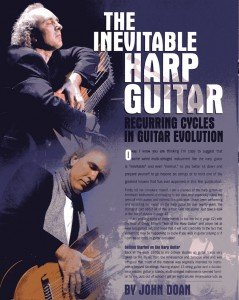
The Inevitable Harp Guitar: Recurring Cycles in Guitar Evolution

Fingerstyle Guitar Magazine - The Inevitable Harp Guitar - no.66 pg40“The Inevitable Harp Guitar- Recurring Cycles in Guitar Evolution” was published in Fingerstyle Guitar Magazine No.66, and is used here with permission. For more information on harp guitar history go to harpguitars.net.

Back in the early 1970’s in my college studies on guitar I was very taken by the music from the renaissance and baroque eras and was intrigued that much of the material was originally intended for instruments beyond six strings. Having played twelve-string guitar and a double neck electric guitar in bands multi-stringed instruments seemed familiar to me. Just out of school I got an eight-course renaissance lute as well as a fourteen-course theorbo to play original lute music and included them in my guitar concerts.

Over time I began to recognize all sorts of multi-stringed instruments in some music shops, museums, and in books on instruments and was curious that hardly anyone played them or even seemed to know much about them. There were various lute-guitars (a.k.a. “lutars”) from late 19th/early 20th century Germany (those who think poorly of them call them “gututes”), Basse-guitares or Schrammel guitars from Europe (especially from Sweden, France, Germany, Italy and Eastern Europe), and harp guitars from early 20th century America.

These guitars all had an extended bass range with up to twelve additional strings. I even found a harp guitar made by Chris Knutsen in Port Townsend, Washington from the late 1890’s with seven additional super-trebles attached to the right of the ordinary six strings of the guitar. In time I acquired a Gibson harp guitar (literally hundreds were made in Gibson’s first twenty years), a Dyer harp guitar (made by the Larson brothers and still popular today especially since adopted by such great players like Michael Hedges and Stephen Bennett, among others), and various lesser known makes. I finally commissioned a twenty-string harp guitar (perhaps the first modern constructed harp guitar design in our times) from John Sullivan and Jeffrey Elliott of Portland, Oregon in 1985 and haven’t looked back since. *(note: William Eaton was building amazing multi-stringed creations of his own even before this). Continue reading